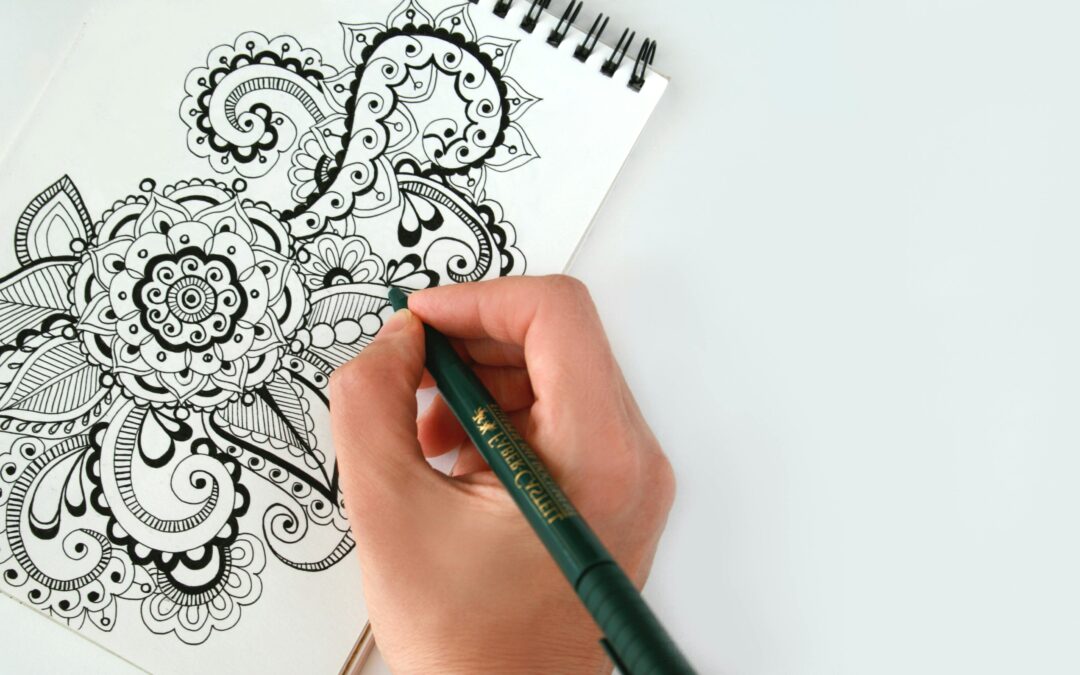
Most of us have been told at some point in our lives to “stop doodling and pay attention.” The assumption is that doodling is mindless, even a sign of distraction. But what if doodling is not only a legitimate form of attention — what if it’s actually a powerful tool for emotional regulation, creativity, and brain balance?
In a world that often pulls us into overthinking, endless scrolling, and constant stimulation, the act of making small, unplanned marks on a page can be a gentle invitation back to ourselves. Doodling — simple, accessible, and judgment-free — can calm the nervous system, integrate the left and right hemispheres of the brain, and open a path to emotional clarity.
Why Doodling Works: The Science Behind the Scribbles
The brain has two hemispheres that are in charge of very different things.The left hemisphere is generally associated with logic, analysis, sequencing, and verbal reasoning. The right hemisphere is more connected to creativity, spatial awareness, intuition, and emotional expression.
Many of us live heavily in left-brain mode — planning, problem-solving, organizing — often because our lives demand it. While these skills are important, an over-reliance on them can leave us feeling mentally fatigued, emotionally disconnected, and creatively flat. The right brain, which thrives on imagery, play, and non-linear thought, can get left out of the conversation.
Doodling, however, wakes up both sides of the brain. The repetitive motion and visual patterning of doodling can stimulate the right hemisphere, while the structure, sequencing, and symmetry that sometimes emerge can engage the left hemisphere. This cross-hemispheric activity not only enhances creative problem-solving but also supports emotional balance.
From a nervous system perspective, doodling can activate the parasympathetic response — the “rest and digest” state — which slows heart rate, relaxes muscles, and brings us back into regulation. Much like mindful breathing, it offers a low-pressure way to anchor ourselves in the present moment.
Doodling as Emotional Regulation
When emotions run high — whether it’s anxiety, frustration, grief, or overwhelm — the thinking brain can get hijacked by the body’s stress response. In these moments, words may be hard to find, and “talking it out” may not feel accessible.
This is where doodling can be especially powerful. By shifting our attention to slow, repetitive marks — swirls, lines, shapes, shading — we give the mind a break from verbal processing and create a safe outlet for emotional energy.
Some people find that their doodles reflect their inner state: tight, jagged lines when they’re stressed; loose, flowing curves when they’re relaxed. Others use doodling as a container for emotions — a place to “pour” feelings so they can be seen and released in a non-destructive way.
What makes doodling unique as a regulation tool is that it doesn’t require talent, planning, or even conscious intention. It’s not about making “art” — it’s about making marks. And in making those marks, we can feel the body slow down, the breath deepen, and the mind begin to soften.
Left Brain + Right Brain in Conversation
Think of doodling as a meeting place between the logical and creative selves.
- The Left Brain says: “Let’s make a pattern, follow a sequence, or draw a grid.”
- The Right Brain says: “Let’s play with color, flow, and movement.”
When we doodle, we allow both to have a voice without either dominating. The left brain feels safe because there’s some order and predictability; the right brain feels free because there’s room for spontaneity and expression.
This balance can be especially supportive in times of stress. When we’re overwhelmed, we may feel scattered and ungrounded (too much right-brain activation without structure) or rigid and shut down (too much left-brain control without creative release). Doodling gently moves us toward the center — where both hemispheres work together.
Mindfulness in Motion
Doodling is also a form of active mindfulness. For people who find traditional meditation challenging, putting pen to paper can be a more approachable way to enter a meditative state.
Here are a few ways to turn doodling into a mindful practice:
- Start with Breath
Before your pen touches the page, take three slow, deep breaths. Let your shoulders drop and your jaw soften. This signals to your nervous system that it’s safe to shift gears. - Choose a Simple Starting Point
Draw a single shape — a circle, square, spiral — and repeat it. Notice the rhythm of your hand. - Follow Curiosity, Not Rules
Let lines lead to other lines, shapes to other shapes. If your mind says, “This is silly,” notice the thought and come back to the sensation of drawing. - Engage the Senses
Pay attention to the sound of the pen on paper, the texture under your fingertips, the movement of your wrist. These sensory anchors keep you rooted in the now. - Pause and Observe
Every so often, stop and notice what’s emerging. Is your breathing slower? Do you feel more centered?
Everyday Ways to Use Doodling for Regulation
- In Meetings or Classes — If your mind starts to wander or your anxiety spikes, doodling can help you stay present without zoning out.
- Before Bed — A few minutes of doodling can quiet mental chatter and prepare your body for rest.
- During Transitions — Whether it’s the end of a workday or the shift from one task to another, doodling can help you reset and refocus.
- When Words Won’t Come — If journaling feels overwhelming, doodle instead. Sometimes pictures can carry what words can’t.
We encourage a “no rules” mindset with creative tools, so doodling becomes an act of permission rather than performance. It’s not about producing something “good” — it’s about giving your brain and body a shared space to unwind, recalibrate, and reconnect.
Your Invitation to Pick Up the Pen
If you’ve ever dismissed doodling as a waste of time, consider this: in a few minutes a day, with nothing more than a pen and a scrap of paper, you can shift your nervous system, engage both hemispheres of your brain, and create a small but meaningful pause in the noise of daily life.
It doesn’t have to look like anything. It doesn’t have to mean anything. And yet, over time, it can become a steady companion — a quiet anchor in a world that often feels unsteady.
The next time you feel scattered, tense, or creatively blocked, try letting your hand wander across a page. You might find that your breath slows, your thoughts settle, and a small doorway opens — not just to calm, but to a more integrated, balanced, and present version of yourself.
Because sometimes, the simplest marks are the ones that bring us home.
The Reflection Project Approach
At The Reflection Project, we integrate practices like doodling into our work with emotional regulation, mindfulness, and nervous system support. Clients often discover that doodling becomes a bridge between their inner world and outer reality — a way to express what’s stirring beneath the surface and to meet it with compassion.