In my work, I often see how people try to create change by focusing only on their mindset. They want to think differently, feel differently, live differently. They set intentions, repeat affirmations, and chase clarity. And yet, despite their best efforts, the changes rarely take root. The reason isn’t lack of willpower or desire—it’s that true integration requires more than thought. It requires rhythm, presence, and embodied meaning.
That’s where ritual comes in.
Ritual is one of the oldest and most natural tools for regulation, connection, and healing that we have. Long before therapy sessions or wellness practices, human beings gathered around firelight, sang, prayed, moved, marked time, and made meaning through shared and personal rituals. Ritual was how we told our bodies that life had structure and our emotions that they had somewhere to go. It’s how we connected to something larger than ourselves—a reminder that we were part of an ongoing rhythm.
The Difference Between Habit and Ritual
We live in a culture that loves efficiency. We build habits to optimize, to get things done faster, to achieve. A habit is something you do automatically; a ritual is something you do intentionally.
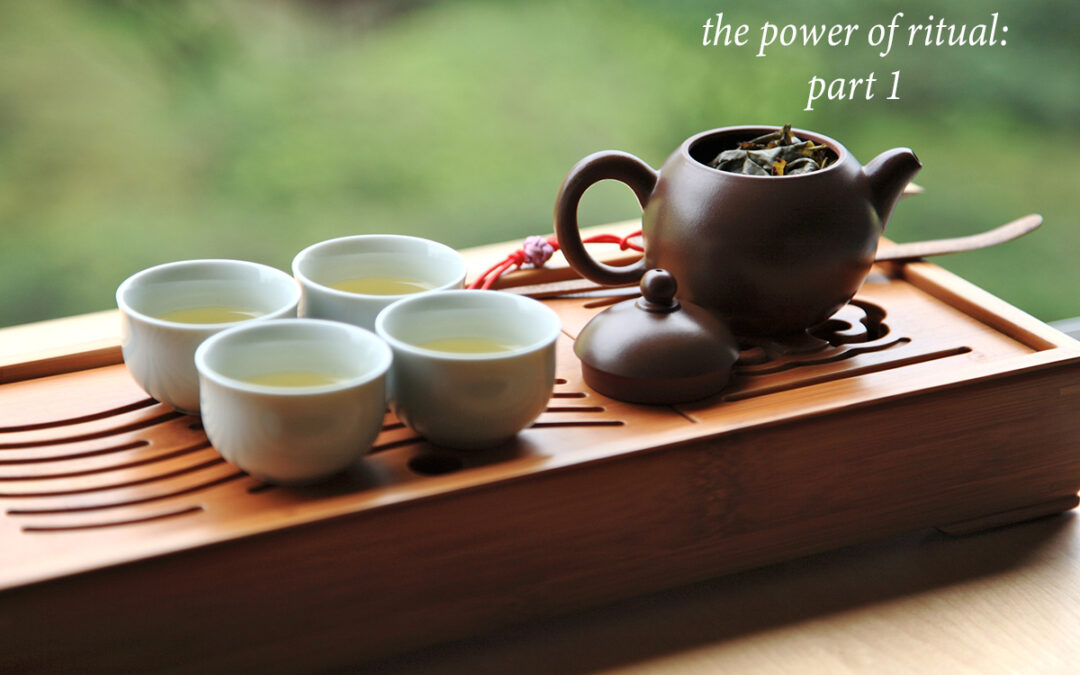
The difference isn’t always in the action—it’s in the awareness. You can drink a cup of tea as a habit, barely tasting it, scrolling your phone while you sip. Or you can drink it as a ritual, feeling the warmth of the mug, noticing the steam, taking a moment to pause before the day begins. The act itself hasn’t changed, but the energy has.
When we add intention, rhythm, and awareness to ordinary actions, they become small ceremonies of presence. These micro-moments tell the nervous system, you are here, you are safe, and this moment matters.
Ritual as a Regulating Force
From a nervous system perspective, ritual creates consistency, and consistency creates safety. Our bodies thrive on rhythm—heartbeat, breath, sleep cycles, the turn of seasons. Yet modern life often pulls us out of these natural patterns. We wake to alarms, rush through meals, skip transitions, and push through fatigue. Our systems lose their sense of rhythm, and with it, the groundedness that allows us to feel at home in our bodies.
Ritual helps restore that rhythm.
Whether it’s lighting a candle before beginning your work, placing a hand on your heart before responding to an email, or ending the day by expressing gratitude, ritual gives your body a pattern to lean into. It builds predictability in a world that often feels unpredictable. Over time, this predictability creates regulation—a felt sense of safety that allows for openness, curiosity, and healing. Rituals done through repetition also support building new neuro pathways literally rewiring our brain.
When the nervous system feels supported, the mind doesn’t have to work so hard to stay positive or in control. Integration—the harmony of thought, feeling, and body—becomes possible.
Ritual as a Bridge Between Worlds
In integrative wellness, we talk about coherence: the alignment between mind, body, and emotion. Ritual is a bridge that connects these realms.
When I create ritual, I’m not trying to escape the world; I’m trying to enter it more fully. A simple act—like breathing consciously before a session, or setting an intention before writing—draws my awareness back into my body. I can feel my feet, my heartbeat, my breath. My mind begins to slow and follow the rhythm of my body. My emotions become less chaotic, more attuned. I remember that I’m part of something living, breathing, and relational.
That coherence—when thought, emotion, and body begin to move together—is what integrative wellness is really about. Ritual becomes both a language and a container for that integration.
The Loss of Ritual in Modern Culture
Many of us have lost our connection to ritual without even realizing it. We no longer have the same shared ceremonies to mark transitions—beginnings and endings, grief and celebration, change and rest. Without these markers, we can feel unmoored, as if life just blurs from one thing to the next without pause.
The absence of ritual often shows up as burnout, disconnection, or a sense of meaninglessness. We crave something to hold us steady, but we try to fill that gap with more doing. What we actually need is being.
When I talk with people about creating rituals, they often imagine something elaborate or time-consuming. But ritual isn’t about performance—it’s about presence. The smallest acts, when done with awareness and intention, can recalibrate the nervous system and reawaken meaning.
Ritual as a Way of Remembering
Ritual, at its essence, is a way of remembering. Remembering what matters, who we are, and what we belong to. It creates a space where we remember to connect with ourselves.
When I light a candle before beginning a session, I’m remembering that I am entering therapeutic space where the opportunity for healing can happen. When I pause between meetings to breathe and release, I’m remembering that my body is part of the process, not just a vehicle for it. When I end the day by washing my hands slowly under warm water, I’m remembering to let go.
Each act of ritual is a conversation between my conscious mind and my deeper self. It’s how I remind my nervous system that life has rhythm, that moments have meaning, and that I can trust myself to tend to them.
Ritual and the Practice of Integration
Integration is not an endpoint; it’s a rhythm—a continual process of connecting, disconnecting, and reconnecting. Ritual helps us stay in relationship with that rhythm.
When life feels scattered, ritual helps gather us. When we’re overstimulated, it slows us down. When we’ve drifted into autopilot, it calls us back to awareness. It gives form to the invisible—our values, our emotions, our longings—and helps translate them into something the body can understand.
This is why ritual is such an essential part of integrative wellness. It engages the sensory body, the emotional body, and the cognitive mind simultaneously. It roots us in safety, meaning, and connection—the three ingredients that allow real transformation to occur.
Ritual as an Invitation to Belonging
At its core, ritual isn’t just about what we do; it’s about how we relate. It reminds us that we belong—to ourselves, to others, to the cycles of nature, to something greater. In a time when many people feel isolated or disoriented, ritual restores a sense of belonging and connection.
Even solitary rituals are relational. When I journal with intention, I’m in conversation with my inner world. When I step outside to breathe under the sky, I’m in relationship with nature. Each act affirms that I’m part of the larger web of life.
Ritual makes the invisible visible. It helps us move from concept into embodiment, from separation into connection, from doing into being.
An Invitation
As you move through your own days, I invite you to notice where ritual already lives in your life—and where it might want to emerge. It doesn’t have to be elaborate or “spiritual.” It might be how you make your morning coffee, how you begin or end your workday, or how you transition between roles. Bring awareness to these moments. Let them become touchpoints of presence and safety.
If you’re longing to reconnect with rhythm, regulation, and meaning, I invite you to explore the resources we’ve created at The Reflection Project. Our guided meditations and integrative practices are designed to help you return to your body, cultivate coherence, and rediscover the power of ritual in everyday life.
Because when we bring meaning into the smallest moments, we don’t just change our days—we change the way we experience being alive.