The holiday season has a way of stirring things in us—old memories, tender longings, expectations, and sometimes pressure. It’s a time when many of us hold joy and grief, connection and boundaries, celebration and fatigue all at once. In the midst of that swirl, we often look for something that helps us feel grounded and present—connected to ourselves, to one another, and to what truly matters.
For me, one of the clearest doorways into that sense of connection has always been tradition.
Not the polished, picture-perfect traditions you see on holiday cards or in commercials, but the quirky, unexpected, deeply human ones—the traditions that make us laugh, bring us together, and anchor us in something real.
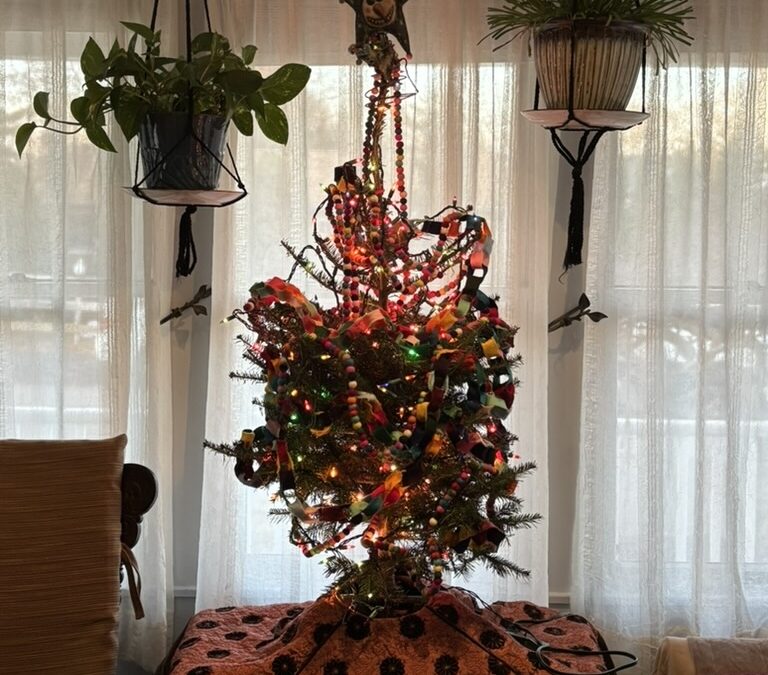
In my family, nothing captures that better than our annual hunt for what we lovingly call The Ugliest Christmas Tree.
The Tradition That Found Us
More than twenty-seven years ago—long before my son was old enough to toddle through a Christmas tree lot—my husband and I stumbled into a ritual that would quietly shape our family life.
Like so many others, we found ourselves wandering tree farms, firehouses, and Home Depot lots, surrounded by rows of perfectly shaped trees and busy holiday shoppers. Then we saw it: wedged between two beautiful specimens stood a tree with sparse branches, no obvious front, and absolutely no redeeming symmetry. It was the kind of tree that made you wonder how it had survived long enough to be sold.
We looked at the tree, then at each other, and burst out laughing. My husband, Michael, cut it down proudly while I stood nearby holding our pugs—dressed in their holiday sweaters—laughing so hard I could barely breathe. I can still hear his laughter.
“There it is,” he said. “The ugliest tree on the lot.”
We brought it home not because it was ironic or charming, but because it felt like us—perfectly imperfect, full of character, and worthy of celebration.
That moment became our tradition. Each year, we made it our mission to find the most pitiful, bewildering, lopsided tree available. If no one stared at us in disbelief or asked, “And you paid how much for that?” we considered the outing a failure.
We began inviting others into the search, asking fellow shoppers and employees for their opinions. Strangers would laugh, debate passionately, and point us toward increasingly tragic contenders. And every year, we drove home with our misshapen treasure tied precariously to the roof of the car, laughing the whole way.
The Tradition That Stayed
Four years ago, my husband passed away.
Loss has a way of rearranging everything—your seasons, your body, your sense of home. The holidays, in particular, can sharpen both the ache and the sweetness.
In that first season without him, my son and I weren’t sure what to keep or what to let go. But when December arrived, one tradition rose to the surface with surprising clarity.
We would still pick out the ugliest tree.
Not out of obligation or nostalgia, but because the tradition itself had become a living connection—to memory, to laughter, and to him. When we stepped onto the tree lot that first year, the ritual held us. It gave us something familiar and stabilizing at a time when everything else felt fragile.
It reminded me of something essential: connection doesn’t always come from grand gestures. Often, it lives in small, embodied rituals that help us feel rooted and real.
Connection Through the Body, Not the Performance
At The Reflection Project, we talk often about how connection begins in the body. Not the performative version of connection—smiling through overstimulation or pushing past your own limits—but the kind that arises from a regulated nervous system and a sense of inner safety.
Traditions, when they are authentic and nourishing, can become powerful anchors for this kind of connection.
Our bodies respond to familiarity. Predictable rituals signal safety. Shared laughter creates co-regulation. Sensory experiences—the smell of pine, cold air on your face, the texture of bark under your fingers—bring us into the present moment.
The Ugliest Christmas Tree tradition isn’t just sentimental for me. It’s somatic. It’s regulating. It’s a reminder that connection doesn’t require perfection—only presence.
This is the foundation of The Reflection Project: healing and meaning don’t come from performing who we think we should be, but from returning to who we already are.
Ritual as Regulation
The holidays can be overwhelming. Lights, sound, social demands, emotional expectations, and memories all compete for our attention. When our nervous system becomes overloaded, genuine connection becomes harder.
Rituals help us come home.
They create predictability in a chaotic season, agency when we feel pulled in many directions, and belonging rooted in shared experience. Rituals ground us in the body and remind us that connection doesn’t have to be complicated.
It can be as simple as a daily cup of tea, a walk after dinner, a pause before entering a gathering—or an annual hunt for the most absurd-looking tree you can find.
When traditions are chosen with intention rather than obligation, they become bridges back to ourselves.
Staying Connected With Ourselves
This holiday season, I invite you to reflect on a few gentle questions:
- What helps your nervous system feel grounded?
- What rituals remind you of who you are beneath the noise?
- What traditions feel nourishing rather than performative?
Connection with yourself is foundational. From that place, boundaries become clearer, presence deepens, and interactions feel more authentic.
Small practices can help:
- Taking a few mindful breaths before gatherings
- Creating moments of solitude
- Naming what you need instead of guessing what others want
- Allowing joy, grief, and nostalgia to coexist without judgment
Connection doesn’t require emotional perfection—only honesty.
Staying Connected With Others
When we reconnect with ourselves, our capacity to connect outward naturally expands.
Consider who feels like home in your nervous system this season. Not who you feel obligated to please, but who allows you to be human.
Authentic connection often grows through shared laughter, playfulness, simple rituals, and moments of co-regulation—walking together, breathing together, resting together.
Each year, when we announce our mission on the tree lot, strangers inevitably join us. Connection can begin in the most unexpected places.
Let This Be Your Season of Real Connection
The holidays don’t need to be perfect. They don’t need to look like anyone else’s version of celebration.
They can be grounding, spacious, and meaningful—filled with moments that help your system exhale.
For my son and me, connection looks like an uneven tree with a story woven through every knot in its trunk. It looks like honoring the past while making space for the present. It looks like ritual as regulation.
And it looks like allowing both joy and tenderness to belong.
A Gentle Invitation
At The Reflection Project, we support individuals in reconnecting with themselves through nervous-system-centered, trauma-informed practices that honor the whole person.
If you’re navigating this season with stress, grief, or a desire for deeper connection, know that you don’t have to do it alone—and you don’t need to become someone you’re not.
You can return to yourself. You can build rituals that help you feel rooted—this season and every one that follows.
May this season bring you moments of laughter, warmth, and connection in all their beautifully imperfect forms.